
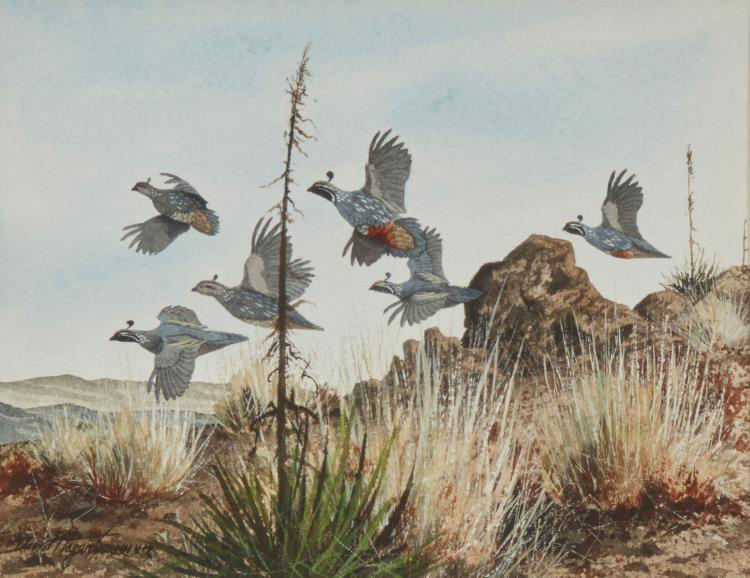
David Hagerbaumer – watercolor, 7 x 9 inches
David Hagerbaumer: A Sportsman’s Artist
Early Life and Influences
Born in 1921 in Quincy, Illinois, David Hagerbaumer grew up during the Great Depression. At age eight, he began duck hunting, trapping, and fishing to support his family. A self-described “river rat,” his love for the outdoors shaped his life and art, rooted in the swamps and river bottoms of Illinois.
Military Service and Early Career
Hagerbaumer served in the Marines during World War II, creating propaganda posters and maps. After the war, he worked as a taxidermist in a decoy factory and briefly attended San Diego State College, studying art without graduating. He later joined the Nevada State Museum as a preparator and became a staff artist at the Santa Barbara Museum in 1957. He would paint at night and sell at weekend shows. Switching from oils to watercolors for their faster drying time, and eventually dedicating himself to art full-time.
Rise to Prominence
Hagerbaumer’s commercial success began in 1956 when he partnered with Ralph Terrill of Crossroads of Sport in New York City. Their catalogue featured his first watercolor prints, published by Frost & Reed in England. His vivid depictions of waterfowl and landscapes, informed by his deep knowledge of terrain and hunting, earned widespread admiration.
Artistic Contributions
Hagerbaumer illustrated several books, including two of his own: The Bottoms (1987) and Waterfowling These Past Fifty Years — Mostly Brant (1998), dedicated to “the little sea geese.” His friend, outdoor writer John Orrelle, showcased his work in David Hagerbaumer, Sporting Images, Etchings, Drypoints & Drawings — Volume I and The Art of A Sporting Life, The Wildlife Art of David Hagerbaumer — Volume II.
Artistic Style and Legacy
Hagerbaumer’s watercolors are celebrated for their authenticity and emotional resonance. Early works reflect minimalist, serene elegance with an oriental simplicity, while later paintings capture dynamic, intimate scenes of waterfowl—bluebills speeding over decoys, mallards landing, or pintails descending against a winter sky. His art evokes primal excitement, uniting birds, landscape, and viewer in harmony.
Beyond watercolors, his black-and-white etchings, drypoints, and drawings depict duck shacks and blinds, preserving a nostalgic record of a bygone era. His versatile style, marked by both reflective and vigorous moods, remains distinctive and unmatched, despite imitators.
Recognition and Passing
Hagerbaumer passed away on February 23, 2014. John Orrelle wrote in his obituary, “With his passing, the world of wildlife art has lost one of the great pioneer painters of the 20th century. Celebrated for his art and revered as a man, his legacy is rich and enduring.” Fellow artist David Maass called him “truly a sportsman’s artist,” skilled with both gun and brush.
Hagerbaumer’s paintings continue to captivate, reflecting a lifetime of enthusiasm for the outdoors and a masterful ability to portray its beauty and challenges.
“I got my break in 1954, when a mentor, Edward Selden Spaulding, showed my work to Ralph Terrill, who managed the Crossroads of Sport in New York City. At that time, there were only a few sporting artists on the scene and only 16 American artists appeared in the Crossroads’ catalog that year. Today, very likely, there are 50 times that number painting the same subjects.
I enjoy a career that let me live where I choose, paint mostly what I want and make a decent living doing so. My goals for the coming year are to do a few watercolors, work on a new book and start painting landscapes in oils again.
I am a loner and that’s how I would like to be remembered. I’ve gone my own way, created my own style, and gathered my own reference material with field sketches and photos. I hope to be remembered as one who did his best and walked his talk.” – David Hagerbaumer