
Featured Artist
Julius Rolshoven (1858-1930)
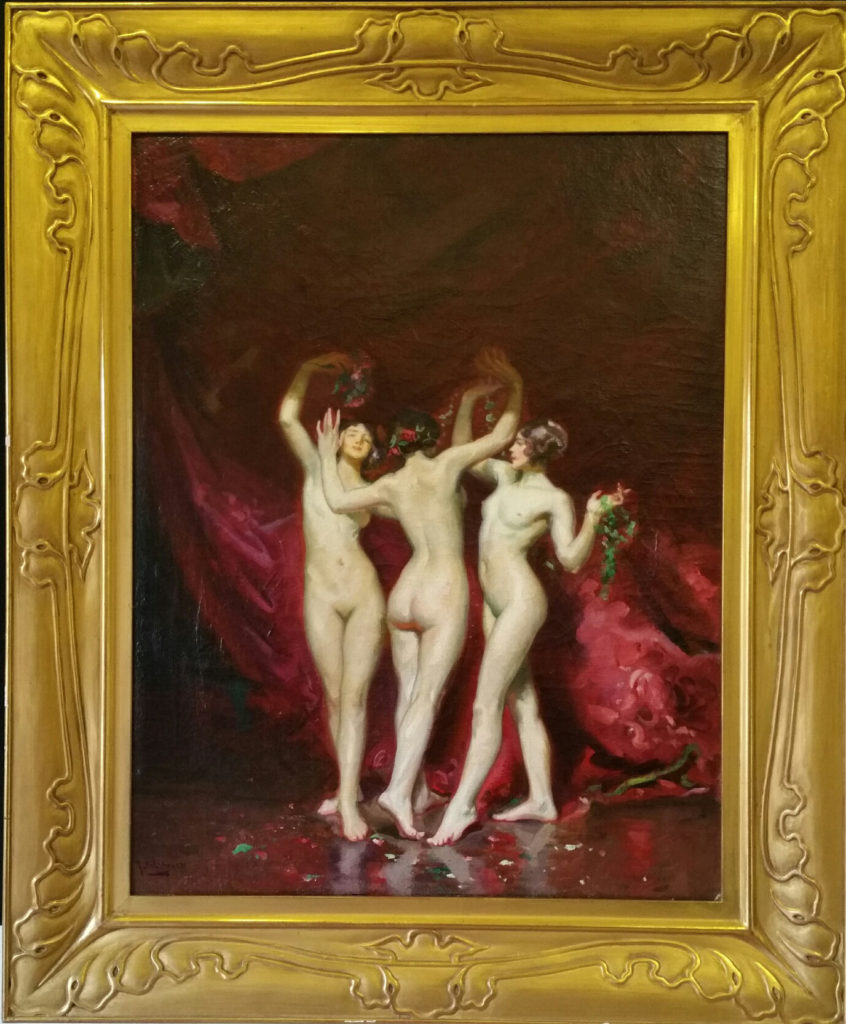
“Three Graces”

Three Graces by Julius Rolshoven
Born on October 28, 1858, in Detroit, Julius Rolshoven, the son of a jeweler, initially attended the Cooper Union Art School in 1876 after being rejected by the National Academy of Design. In 1878, he continued his artistic education at the Düsseldorf Academy under the guidance of Hugo Crola, a portraitist. Afterward, Rolshoven moved to Munich, where he studied under Ludwig von Löfftz and became one of the “Duveneck Boys.” During this period, he spent a year in Venice and some time in Florence, with his work “Florentine Boys” (1884) displayed at the Detroit Institute of Arts.
His artistic journey led him to Paris, where he studied at the Académie Julian under the tutelage of Bouguereau and Robert-Fleury. In 1885 and 1889, his works were featured in the annual exhibitions of the National Academy, marking a significant achievement in his career. In 1889, Rolshoven was…
Read more about the artists
Henry Charles Baron, a French artist born in 1816 and passing away in 1885, received his artistic tutelage under the guidance of his compatriot, Jean Gigoux. In 1840, Baron made his debut at the Salon with two captivating paintings that Théophile Gaultier lauded as “abounding with emotion and vibrant colors.” His artistic prowess earned him the distinction of third-class medals in 1847, 1855, and 1867, the latter at the World Expo. Furthermore, he achieved the prestigious second-class medal in 1848 and was bestowed with the honor of becoming a Knight of the Legion of Honour in 1859.
Works Available on this website:
“Mother and Children”
Mary Boggs, an interior designer by occupation, captures the true essence of nature in her paintings, in both watercolor and oil mediums. Collections of her works have appeared at numerous art shows throughout southern Florida. An Alabama native, she finds her inspiration living in the tropical beauty and tranquility of Key Largo in the Florida Keys.
Mary’s signature on her paintings has become synonymous with quality and is on prominent display in many homes and businesses throughout the Keys, across the state, and in homes across the nation.
Of painting, Mary says that an artist needs inspiration to create realism. “Living in Paradise, the Florida Keys, will inspire me forever.
Works Available on this website:
Born in Great Falls, Montana, and currently residing in Hamilton, Montana, Mari Bolen has established herself as a professional artist with a career spanning since 1964. Over the years, she has contributed her artistic talents in various roles, serving as an illustrator for the Department of Fish and Game and Montana State University. Additionally, she held positions as an Educational and Commercial TV Art Director in both California and Arizona.
During her career, Mari Bolen also shared her expertise with others, teaching sculpture at the University of California and San Jose Unified Schools, primarily in evening classes.
In 1980, she made the decision to return to her home state of Montana, where she dedicated herself to a full-time career in sculpture. She has earned recognition for her exceptional work in figurative and portrait art, particularly known for her depictions of Plains Indians and other historical figures encountered during the Lewis and Clark Expedition.
Furthermore, Mari Bolen is a founding member of the Montana Professional Artists Association and actively serves as its president. Her artistic contributions have been celebrated through numerous awards, including the prestigious People’s Choice and Best of Show titles, which she has earned six times in exhibitions organized by this association and various others.
Works Available on this website:
“Arapaho”
Carl W. Brandien, born on July 24, 1886, in New York City to Danish parents, faced early adversity as his father passed away during his childhood, leading to his placement in an institution. Serving with distinction in the American Expeditionary Forces in France during World War I, he was honorably discharged on June 4, 1919. He later passed away on January 1, 1965, in Ft. Lauderdale, Florida, with the location yet to be confirmed.
Brandien married Hannah Ermine Kathleen Kirschbaum, known as “Kaye,” on January 27th, 1937, at the Church of the Transfiguration on East 29th Street in New York City. Kaye, born on June 30, 1898, in Hampstead, England, survived the sinking of the liner Lusitania at the age of 16 and became a naturalized U.S. citizen on May 20, 1944. She passed away on September 24, 1963, in Ft. Lauderdale, Florida.
The couple, with an age difference of 12 years, formed a unique bond when they met on a California-bound steamer. Their marriage marked the beginning of their joint journey as the “Vagabonds,” embarking on a pilgrimage named “Vagabondage” or the “quest of life.” Their goal was to “discover and paint beauty in all corners of the world,” leading to Brandien’s recognition as the Vagabond Artist. His trademark 42-pound knapsack carried essentials during their 7-year quest from 1930 to 1937.
Noteworthy exhibitions and awards punctuated Brandien’s career, with frequent showcases at Ainslie Galleries, Fifth Ave, New York, and notable awards from the National Academy of Design. His diverse artistic contributions ranged from being an illustrator for Life Magazine to painting murals for renowned establishments.
Brandien’s travels, documented in various newspapers, included a perilous incident in Tunisia where he painted a Moslem burial ritual, narrowly escaping harm due to his recognition as a veteran of the “Great War.”
After moving to Ft. Lauderdale in 1941, the couple made it their permanent home two weeks before Pearl Harbor. Brandien’s artistic legacy continued in Florida, marked by various exhibitions and contributions to local art guilds.
Brandien and Kaye, buried in Arlington National Cemetery, left an indelible mark on the art world, with their inspiring journey and artistic achievements.
Source: Alfred R. Frankel, MD (Artists of Old Florida Website)
Don Brown was a notable member of the Indian River School of Painting, an informal collective that emerged in the 1950s and 1960s in Florida. Although not a formal institution, this group primarily consisted of African-American individuals from the working class who harbored a shared passion for painting.
The Indian River School, denoting Floridian artists from the mid-20th century, showcased a strong connection to nature, with a majority of its members being of African-American descent. Characterized by swift brushstrokes, their artwork diverged from traditional painting methods. A key influencer for the group was A.E. Backus, a Bohemian white individual who served as a mentor to this community of young black artists. Gathering in Backus’s studio, affectionately known as ‘Beanie,’ these artists found an escape from their lower-class labor jobs through the art of painting.
Their creations, marked by powerful and dramatic aesthetics, skillfully captured the tranquility and beauty of the Florida countryside. Although the exact count of artists mentored by A.E. Backus remains unknown, experts estimate it to be around 20 individuals, many of whom he supported through college. Several of these artists continue to paint, showcasing and selling their works in galleries and online platforms. Notably, some pieces may be challenging to locate as they reside in private collections.
Known Artists of the Indian River School of Art:
A.E. Backus (‘Beanie’) – 1906-1955
Don D. Brown
James Hutchinson
Therese Knowles
Margaret Z. Smith-1925-2005
Julie Enders
Annie Nobles Miller
Jackie Schindehette
Jackie Brice
Some famous Paintings and Art of the Indian River School:
A.E. Backus (‘Beanie’) – Fire Sky
Don. D. Brown- The Offering
James Hutchinson- Jacaranda Shade Florida, Tropical Poinciana
Theresa Knowles-La Source and Ferns at the Spring
Jackie Schindehette-Double Red
Roseate Spoonbills-Jewels of Nature
Museums, Galleries or Exhibitions of the Indian River School of Art:
A.E. Backus Museum and Gallery
The Hutchinson Gallery
Works Available on this website:
“Everglades“ – SOLD
Renowned New Jersey artist Michael Budden has built a distinguished career as a painter, initially focusing on the captivating wildlife found across North America. However, his current artistic focus has shifted towards capturing the vibrant scenes of New York City, the picturesque landscapes along the Delaware River and its neighboring towns, as well as the captivating vistas from the east coast to the Rocky Mountains.
Budden passionately states, “We live in such a beautiful and varied country. We are lucky that we are easily mobile and can get out and experience nature first hand.”
Budden’s artistic signature lies in his ability to infuse his creations with strong design, confident brushwork, and an exceptional quality of light. In his own words, “The challenge of painting on location emphasizes what truly excites me as an artist. It is derived from the heart, very challenging, but fun and freeing up of one’s art spirit. Although I also work in the studio, nature is the best teacher and inspiration.”
Throughout his illustrious career, Michael Budden has received numerous accolades, with standout achievements including the honor of designing the 2006 White House Easter Egg representing New Jersey and the privilege of meeting with First Lady Mrs. Bush at the White House exhibition.
His recent accomplishments include securing two prestigious awards at the Salmagundi Club in New York City: the 2008 Purchase Award for the Flatiron and the “2009 Alden Bryan Memorial Award for Traditional Landscape in Oil. Michael Budden’s artwork is not only cherished in private collections but has also found a place in three major museums dedicated to wildlife art, in addition to numerous private and corporate collections.
Budden’s art revolves around capturing specific moments in particular locations, often ignited by the interplay of light. As he eloquently puts it, “It’s the light that grabs you. Makes you stop and look and want to paint.” His paintings not only compel viewers to pause and admire but also resonate deeply with collectors, stirring their hearts and evoking their appreciation for the beauty he so skillfully portrays. In his own words, “I have been extremely lucky in my career as an artist. I continue to search, to get better as an artist, and I feel.”
Works Available on this website:
“Heading to Central Park”
“In Front of the Plaza”
“Wild Turkeys”
Born in Bangor, Maine, in 1820, Frederick Butman was a prominent figure in the art and business community of Gardiner, Maine. Operating an apothecary shop, he played a vital role in the foundation of the local gas and water company. Despite lacking formal instruction, Butman displayed a remarkable talent for painting figure studies.
In 1857, Butman relocated to San Francisco, where he showcased his artistic prowess by exhibiting the earliest known painting of Yosemite Valley at the Mechanics’ Institute Fair. He emerged as one of the pioneering artists in California, dedicating himself exclusively to landscapes, with a special focus on Yosemite. During the 1860s, he expanded his artistic horizons, working in Oregon’s Columbia River area and Washington. His exhibitions in San Francisco featured a diverse array of mountain scenes, including breathtaking views of Mt Shasta, Mt Hood, and Lake Tahoe.
In 1867, Butman returned to the East Coast and captivated audiences with his awe-inspiring depictions of the American West. He ventured to Europe, where he sketched the scenic landscapes of France, the Pyrenees, and the Swiss Alps. Butman’s return to San Francisco in 1869 marked a triumphant homecoming, and he continued to create masterpieces, producing approximately 80 paintings in California. His remarkable talent garnered high praise from the local press, and his works commanded substantial prices during his lifetime.
Tragically, Butman’s life was cut short during a family visit to his hometown. He unexpectedly passed away in Gardiner on July 26, 1871, leaving behind a legacy of artistic brilliance and a body of work that continues to be celebrated today.
Works Available on this website:
“Triptych”
Born in Edinburgh, Scotland, James Howe Carse, the son of Alexander Carse, known as ‘Old Carse,’ emerged from a lineage of Scottish painters. Alexander, renowned for Scottish genre scenes from 1802 to 1838, likely inspired James Howe’s artistic path. James Howe Carse was named after the contemporary Scottish animal painter, James Howe. Although the details of his birth remain elusive, historical accounts place it around 1818 or 1819.
Trained at the Royal Scottish Academy, James exhibited landscape paintings in London between 1860 and 1862. Notably, “An Old Mill on the Avon near Bathgate, Looking towards the Firth of Forth,” showcased in 1860, marked his presence. His London residence during this period was at 24 Edward Terrace, Caledonian Road North. In 1867, James Howe Carse likely arrived in Australia, initially seen in South Australia and later exploring Victoria and New Zealand by 1869.
In 1869, his artwork, including “Riddell’s Creek, Mount Macedon,” gained recognition in Melbourne, and he contributed to Edwin Carton Booth’s “Australia Illustrated.” The engravings in this publication, attributed to ‘J. Carr,’ highlighted diverse Australian and New Zealand landscapes.
A pivotal figure in the Australian art scene, Carse became a founding member of the Victorian Academy of Arts in Melbourne in 1870. His sojourn in New South Wales commenced in 1871, where he adopted various aliases, including J.H. Carr and James Carr. His contributions to the New South Wales Academy of Art earned him a certificate of merit in 1872 for “Weatherboard Falls.”
In 1873, Carse secured the Hon. John Campbell’s prize for “Loch Oich and Inverary Castle, Scotland.” This accolade underscored his ability to capture the sublime beauty of landscapes. He continued to exhibit prolifically, earning certificates of merit for works like “Bega Swamps” in 1875.
Carse’s reputation soared in 1876, winning a gold medal for his depiction of “Weatherboard Falls” and displaying genre scenes like “The Morning Herald” and “The Evening News.” The following year, he was lauded as ‘perhaps the best painter in the colony’ and faced critique for his use of vibrant greens in landscapes like “The Jump-Up, Road into Burragorang.”
A foundational member of the Art Society of New South Wales since its inception in 1880, Carse focused on painting the south coast’s scenic views. Over the years, his submissions to the society’s exhibitions waned, with critics noting a departure from his earlier brilliance.
In the latter part of his life, Carse resided in Mosman Bay, possibly with his longtime friend, the painter George Podmore. Unfortunately, his life was marred by alcoholism, leading to his demise in 1900. His extensive body of work, primarily in oils, reflects a quiet romanticism, often portraying the interplay between humans and nature. His legacy endures, capturing the essence of Australian landscapes with a unique artistic vision.
Works Available on this website:
(currently none – sorry)
Known for: Marine, landscape and portrait painting
Works Available on this website:
“Landscape“
Thomas Aquinas Daly is an American contemporary landscape and still life painter, graphic artist and magazine illustrator of hunting and fishing genre. Using nuances of light and atmospheriecs, Daly strives for a poetic tone in his oil and watercolor painting,s reflecting his reverence for land and nature and his sportsman’s love of roaming the landscape. On his website, Daly cites a critic’s comments as an accurate reflection of gentle approatch to his creativity: “His work is about the land—quiet, confident meditations upon the spirit of a place without the need for assertiveness.”
Educated as a graphic artist at the University of Buffalo, Daly spent 23 years working in the commercial printing business before leaving it in 1981 to devote his full attention to painting. Since then, his work has been displayed in numerous solo exhibitions at galleries, museums and universities throughout the country.
President Gerald R. Ford recognized Daly’s talent by awarding him Grand Central Art Galleries’ Gold Medal at the opening of his 1987 show in New York. In addition to painting, Daly has produced two books: Painting Nature’s Quiet Places (Watson-Guptill, 1985) and The Art of Thomas Aquinas Daly: The Painting Season (1998).
Works available on this website:
Nicolò De Corsi (1882–1956), also known as Nicola or Nicolas De Corsi, was an Italian painter associated with Impressionist and Modernist styles. Born in Odessa (now Ukraine) to an Italian family, he primarily worked in southern Italy, particularly Naples and Torre del Greco, where he spent much of his career and eventually died. His art focused on coastal and maritime scenes, including Neapolitan seascapes, harbors, fishing boats, and views of the Gulf of Naples, often capturing morning light, everyday life, and the region’s vibrant landscapes. He worked in various media such as oil on canvas or panel, gouache, and watercolor.
De Corsi’s works are collectible, frequently appearing in auctions, with pieces like a 1919 oil painting of an Italian harbor or gouache depictions of Neapolitan harbors selling through houses such as Finarte and Casa d’Aste Arcadia. His style reflects early 20th-century Italian regionalism, emphasizing light and atmosphere in everyday coastal motifs.
Works Available on this website:
“Venice“
Edwards was born on September 5, 1884, in Frankfort, IN. In his early years, Edwards found himself immersed in the world of entertainment as a daredevil and clown within a circus setting. Around 1910, he made a significant move to Los Angeles, where he dedicated two decades of his life to teaching stagecraft at Lincoln High School.
Edwards showcased his literary talent during this period by authoring a play titled ‘Flamingo Arrow.’ His profound interest and expertise in American Indian culture led him to establish the Yato Kya Indian Museum in 1928, situated in the picturesque Antelope Valley.
Edwards, whose artistic journey was largely self-taught, ventured into Cubism experimentation during the 1920s. However, his primary artistic identity rested in the realm of Impressionism. Through delicate and feathery brushstrokes, he masterfully crafted traditional landscapes that reflect his deep connection to the artistic form.
Edwards died in Lancaster, CA on July 19, 1953, leaving behind a legacy that intertwines his daring circus roots, educational contributions, literary endeavors, and artistic explorations.
Exh: Group of Independents (LA), 1923; Eagle Rock Artists, 1929. AAA 1925; SCA.
Works Available on this website:
“Nakomis“
Nick Eggenhofer, hailing from Gauting, Bavaria, is celebrated as a renowned painter whose work predominantly captures the romance and essence of the American West, replete with its iconic imagery of cowboys and Native Americans. His distinct reputation for historical accuracy is a direct result of his assiduous research, making him a recognized authority on the topic of frontier western transportation.
The seeds of Eggenhofer’s fascination with the American West were sown during his formative years, primarily through stories of Buffalo Bill’s Wild West Show in Germany, shared by older relatives who had been fortunate enough to witness the captivating performances. This intrigue found further nourishment through American western cinema, ultimately propelling him towards a lifelong devotion to the subject.
In 1913, at the tender age of sixteen, Eggenhofer embarked on a life-altering journey to the United States, relocating with his family from Germany. Three years later, he enrolled in evening art classes at Cooper Union in New York, dedicating himself to this pursuit for a commendable four-year period. In the daytime, his education continued as he delved into the realm of lithography at the American Lithography Company, an establishment known for grooming a multitude of accomplished artists.
Subsequently, he established his own illustration studio in New Jersey, which served as the epicenter of his livelihood. As a commercial artist, he lent his artistic talents to the illustration of countless western magazines and books throughout the 1920s to the 1940s. An aficionado of the American West, Eggenhofer expanded his passion by amassing an impressive collection of western artifacts, including saddles, firearms, and indigenous paraphernalia. His talents extended beyond visual artistry, as he also penned and illustrated the comprehensive tome “Wagons, Mules, and Men: How the Frontier Moved West.” This notable work meticulously chronicled the history of pack animals, wagons, carts, and stagecoaches that played pivotal roles in the transportation of people on the western frontier. Furthermore, his dedication to preserving the legacy of the American West saw him craft a series of ten scale models of Conestoga Wagons for the Whitney Gallery of Western Art in Cody, Wyoming.
In a pivotal shift during the 1960s, Eggenhofer undertook a geographical relocation, bidding adieu to his abode in West Milford, New Jersey, in favor of Cody, Wyoming. It is a town bearing the name of Buffalo Bill Cody, the very showman whose spectacles first ignited the flames of his lifelong passion for the rich tapestry of western life.
Works Available on this website:
“Medicine Man“
Arlene’s passion for arts and crafts ignited during her early years and has remained a lifelong pursuit. She began her professional journey as a painter in the late 1990s and early 2000s. Arlene has explored various art mediums, including oil, acrylic, and watercolor, and has created substantial bodies of work in diverse styles and techniques. She expanded her knowledge through classes with organizations like the WAG and SAC, continuing education, and by learning from artists she admires.
Beyond her artistic endeavors, Arlene finds immense joy in teaching art and sharing her passion with others. She believes in the importance of passing down creative techniques through generations, and she has dedicated many of her classes to honor the teachers and peers who have influenced her over the years.
In 2018, Arlene had a unique opportunity to open a pop-up art gallery in Portland, Oregon, thanks to the generosity of an ambitious cousin. The Arlene Enns Gallery was a six-month dream realized, leaving an indelible mark on her artistic journey. Today, Arlene continues to sell her artwork locally and online, attracting collectors from Canada, the United States, and even Europe.
Recently, she ventured into the world of wearable art, collaborating with Le Galeriste, a company based in Montreal. Her clothing line can be found on her online storefront via her “Art with Arlene” Facebook page and at various artisan shows she participates in annually.
Arlene’s message is one of encouragement, urging others to pursue their dreams and live life with purpose.
Works Available on this website:
“The River“
“The Olivia“
“Leaving Dominican“
“Backyard Beauty“
“Australian Waterfall“
“Apocalyptic Thaw“
Emile Albert Gruppe was born in Rochester, New York in 1896. The son of Charles Paul Gruppe who was recognized by the Dutch as being one of America’s most gifted painters of the late 19th Century. Emile was trained by his father and studied at the National Academy in New York City and the Carnegie Art School. He studied under Charles Webster Hawthorne, John F. Carlson and George Chapman.
Gruppe was gifted in his ability to paint almost any subject whether a landscape, harbor scene or the human figure ( mostly nudes). He was able to produce a large painting (30 x 36 inches) in a matter of hours. I bought one such landscapes from a local artist in Rochester who said he spent the afternoon with Gruppe in his studio and watched him complete the painting. After painting it, Emile gave him the painting. That was late in his career, he was able to turn out a huge volume of work and certainly had a great following for his paintings. He was so prolific, I believe he produced thousands of paintings, as a dealer I have sold in my 30 plus years of art dealing hundreds of his paintings. I tend to like his earlier works from the late teens to the early 1950’s. However, it is my experience that his works from all periods are appreciated and sought after.
I believe his largest component of success is the use of color and heavy brushwork producing wonderful impressionistic paintings, this is what I hear from collectors and other dealers. He used bold colors, with heavy impasto, his paintings for the most part are up-lifting and happy. Needless to say he was a master of all moods and atmosphere. He enjoyed what he was doing, the more he painted the easier it became.
He was a member of many art organizations including the Salmagundi Club, The Rochester Art Association, Grand Central Art Galleries, North Shore Art Association and many more. His works are in many museums and private collections. As you can see by his paintings of Lily Pads he was like so many artists influenced by Claude Monet. His early nudes also demonstrate a French Style of painting. His paintings ranged from New England to Florida and even a few show up from Utah. As well as being the gifted painter he was he was a teacher of art and he produced three books: Gruppe on Painting, Gruppe on Color, & Brushwork
for the Oil Painter.
Bio by Michael A. Latragna.
Works Available on this website:
“Autumn in Vermont“
“The Blue Gate” (no longer available)
“Bend in the River” (no longer available)
Robert C. Gruppe, a contemporary artist following the impressionist tradition, was born in 1944. He hails from a lineage steeped in artistic heritage, being the son of the legendary Emile A. Gruppe and the grandson of Charles Paul Gruppe. Through his plein-air paintings, Gruppe skillfully captures the essence of his native Gloucester, bringing to life its landscapes and harbor scenes with a distinct touch that reflects his evolving personal vision and unique style. His artistic endeavor is rooted in the intention to encapsulate the interplay of light, motion, and mood within each composition he encounters.
Gruppe’s artistic journey was greatly influenced by his father, Emile A. Gruppe, with whom he studied for two decades. A product of the Gloucester School of Art, he also received instruction in drawing under the guidance of sculptor George Demetrios. In his current body of work, Gruppe embarks on a personal artistic exploration, delving deep into the physical and expressive attributes of his paintings. He conducts meticulous studies of design, composition, and technique on smaller canvases, ultimately translating these insights into larger works that unveil his spirit of curiosity and the full potential of his artistic vision and talent.
Notable Awards:
- Gordon Grant Award
- Virginia Thomas Award
- Annie T. McCarthy Award
- Philip Hall Award
- Frederick Reinhardt Award
- A.B. Kingan Award
- C. Richard Clark Memorial, 1st prize
- Judges’ Choice Award
- Maynard Scranton Award
- Gertrude Single Award
- Samuel Levin Award
- Virginia Thomas Award (again)
- Frederick Flatow Award
- Rocky Neck Colony Award
- Frederick Mulhaupt Memorial Award
- Great Gatsby Award
- Helen Van Wick Award
Robert C. Gruppe proudly carries on his artistic legacy in the historic Rocky Neck Art Colony of Gloucester, just as his father Emile Gruppe and his grandfather Charles Paul Gruppe once did.
Works Available on this website:
“Naples Evening on the Gulf“
Early Life and Influences
Born in 1921 in Quincy, Illinois, David Hagerbaumer grew up during the Great Depression. At age eight, he began duck hunting, trapping, and fishing to support his family. A self-described “river rat,” his love for the outdoors shaped his life and art, rooted in the swamps and river bottoms of Illinois.
Military Service and Early Career
Hagerbaumer served in the Marines during World War II, creating propaganda posters and maps. After the war, he worked as a taxidermist in a decoy factory and briefly attended San Diego State College, studying art without graduating. He later joined the Nevada State Museum as a preparator and became a staff artist at the Santa Barbara Museum in 1957. Painting at night and selling at weekend shows, he switched from oils to watercolors for their faster drying time, eventually dedicating himself to art full-time.
Rise to Prominence
Hagerbaumer’s commercial success began in 1956 when he partnered with Ralph Terrill of Crossroads of Sport in New York City. Their catalogue featured his first watercolor prints, published by Frost & Reed in England. His vivid depictions of waterfowl and landscapes, informed by his deep knowledge of terrain and hunting, earned widespread admiration.
Artistic Contributions
Hagerbaumer illustrated several books, including two of his own: The Bottoms (1987) and Waterfowling These Past Fifty Years — Mostly Brant (1998), dedicated to “the little sea geese.” His friend, outdoor writer John Orrelle, showcased his work in David Hagerbaumer, Sporting Images, Etchings, Drypoints & Drawings — Volume I and The Art of A Sporting Life, The Wildlife Art of David Hagerbaumer — Volume II.
Artistic Style and Legacy
Hagerbaumer’s watercolors are celebrated for their authenticity and emotional resonance. Early works reflect minimalist, serene elegance with an oriental simplicity, while later paintings capture dynamic, intimate scenes of waterfowl—bluebills speeding over decoys, mallards landing, or pintails descending against a winter sky. His art evokes primal excitement, uniting birds, landscape, and viewer in harmony.
Beyond watercolors, his black-and-white etchings, drypoints, and drawings depict duck shacks and blinds, preserving a nostalgic record of a bygone era. His versatile style, marked by both reflective and vigorous moods, remains distinctive and unmatched, despite imitators.
Recognition and Passing
Hagerbaumer passed away on February 23, 2014. John Orrelle wrote in his obituary, “With his passing, the world of wildlife art has lost one of the great pioneer painters of the 20th century. Celebrated for his art and revered as a man, his legacy is rich and enduring.” Fellow artist David Maass called him “truly a sportsman’s artist,” skilled with both gun and brush.
Hagerbaumer’s paintings continue to captivate, reflecting a lifetime of enthusiasm for the outdoors and a masterful ability to portray its beauty and challenges.
Works Available on this website:
“Moving off the ridge – Wild Turkeys“
“Covey of Bob White Quail“
“Mallards on the Rise“
“Swans” – (in round)
Sources include:
National Museum of Wildlife Art
William Hart was born in Paisley, Scotland, and gained recognition for his serene and romantic landscapes characterized by finely executed brushwork. His signature style often featured cattle and realistic figures integrated into expansive landscapes, a motif he developed starting in the late 1880s after being inspired by the Lower Keene Valley in northern New York state. At the age of 18, he also ventured into portrait painting.
As a second-generation painter of the “Hudson River School,” William Hart followed in the artistic footsteps of his brother James McDougal Hart. Their sister, Julie Hart Beers, also achieved success as an artist. Influenced by George Inness and Asher Durand, Hart was largely self-taught despite these influential figures.
Hart’s contributions to the arts were manifold: he served as the first president of the Brooklyn Academy of Design and was an instructor there. Additionally, he founded and served three terms as president of the American Watercolor Society. His landscapes, widely admired for their popularity, were regular features at exhibitions held by the National Academy of Design and the American Art Union. As a respected teacher, Hart mentored notable artists such as Homer Martin and Lemuel Miles.
Beginning his artistic journey in Scotland, Hart immigrated to Troy, New York, in 1831 as a young boy. He apprenticed as a coach-maker with Eaton and Gilbert, where he painted decorative panels. Subsequently, he worked as a window-shade decorator and portrait painter, operating from his father’s woodshed and selling his works for five dollars each. After returning from Scotland to the United States, Hart established studios in Albany, New York City, and Brooklyn. He and his wife, Janet Wallace of Scotland, spent their later years in Mount Vernon, New York, likely to be close to the family of a deceased son who passed away at the age of 37.
From 1849 onward, Hart embarked on extensive travels across the United States, including stays in Richmond, Virginia, and Michigan, where he spent several years. Many of his paintings during this period depicted dramatic seascapes along the Maine coast, particularly scenes from Grand Manan Island.
Works Available on this website:
John Inglis, originally from Dublin, Ireland (born in 1867), studied at the Dublin Academy then at the Ecole des Beaux-Arts under Jean-Léon Gérôme. At the Académie Colorossi his teachers were Raphaël Collin and Gustave Courtois.
Inglis settled in Rochester, New York, where he was active in the Rochester Art Club, and served as president. He taught at the School of the Mechanics Institute.
With his academic European training, Inglis was regarded as a learned senior painter. His basically conservative style included elements of Impressionism. At the Art Exhibition of the Rochester Industrial Exposition in 1925, Inglis won a gold medal. For his genre scene, A First Sledding, Inglis won a silver medal at the same show five years later. The Memorial Art Gallery of the University of Rochester has his Old Homestead.
Inglis was honored with a one-man show in the fall of 1939, and he was one of the founding members of the Rationalists, self-declared “liberal-conservatives,” who wished to uphold “logic and order” in the Fine Arts.
Inglis was active in exhibiting his works at Brodhead Gallery in Rochester. He died in 1946.
Works Available on this website:
“Spring Blossoms” – SOLD
Born on August 3, 1873, in the enchanting city of Paris, France, Louis Aston Knight was the son of American parents. He began his artistic education in his hometown, studying under notable mentors such as Lefebvre, Robert-Fleury, and his father, D. R. Knight.
In 1925, during his stay at San Francisco’s iconic Palace Hotel, Knight’s creativity flourished as he crafted cityscapes and captured the grandeur of the Palace of Fine Arts. His artistic exploration extended to the picturesque landscapes of the Monterey Peninsula and Santa Monica. His work continues to stand as a testament to his ability to translate nature’s beauty onto the canvas. Knight’s art found a home in esteemed institutions such as the Toledo Museum, Luxembourg Museum, and Newark Museum. His legacy endures, offering a glimpse into the vibrant life of the early 20th century and the world through his eyes.
Works Available on this website:
“Paris Riverscape” (no longer available)
George Kovach, born of Hungarian descent in Cleveland, Ohio, discovered his passion for art during his childhood on an Ohio farm. Capturing the beauty of the surrounding countryside became a focal point of George’s life. He pursued his artistic education at the Art Institute of Miami, graduating and transitioning to a full-time artist in 1972.
Currently, George actively paints at his residence in Texas or his summer studio in New Mexico. A founding member of the Texas Cowboy Artist Association, George earned a gold medallion for best oil painting for three consecutive years. In 1976, at the request of Governor Dolph Briscoe, he represented Texas for the state’s Cultural Achievements during the Bi-Centennial celebrations in Philadelphia.
George played a significant role in co-illustrating “XIT, The American Cowboy,” a major publication by Oxmoor House. His accomplishments were recognized by US Art magazine in December 1993, where he was featured as one of the Top 10 Artists to watch for in 1994 and among the Top 25 Artists of 1993. His print, “Harvest at Holy Hill,” sold out and ranked among the Top 25 prints of 1993 in galleries nationwide.
His artistic talent extended to various commissions, including puzzles, calendars, and notecards distributed in Japan. AMCAL commissioned him for 1996 and 1997 calendars, notecards, and Christmas cards. Additionally, George worked on two collector plate series, figurines, and limited edition villages.
George Kovach’s landscapes convey a profound sensitivity and warmth, reflecting the artist’s connection to the canvas. Characterized by a concise and quiet manner, George upholds the integrity of his profession, aiming for authenticity and accuracy in each piece. In his own words, “painting is a way of communicating my thoughts and feelings and the joy that I receive from my art.” His paintings, designed to take viewers on a personal journey through time, revive the romance of the past.
Works Available on this website:
“Two Rocky Mountain Rams“
Scott Leighton, was born Thomas Leighton in Dover, N.H. and was the fourth child among five born to Nicholas and Deborah M. (Whitney) Leighton on August 28, 1847. He was 50 years of age when he passed away in Waverly, MA, on January 8th 1898.
He married Sadie L. Wyman on November 28, 1870 in Portland, and a few months later on January 1, 1871 the couple also had a more formal church wedding. Scott and Sadie never had children, and are both buried at the Universalist Churchyard in Falmouth, ME.
Scott Leighton’s legacy earned him the title of the “Landseer of the United States,” as noted in his obituary in the New York Times on January 19, 1898. His expertise lay in portraying horses, and he gained recognition for his remarkable paintings in this genre. Some notable works include “Lamartine” and “Barn Yard Altercation”, which are featured in various museum collections and continue to command high prices in auctions.
Scott got an early start in a career in horse-trading at the age of 14, and by age 17, he had accumulated sufficient funds to establish himself as a painter in Portland.
Under the guidance of Harrison Bird Brown, he refined his artistic skills, focusing not only on landscapes but gaining renown for his equestrian compositions.
From 1880 onward, Scott maintained a studio in Boston and resided at the Revere House, a popular meeting place for horse owners and trainers. His lithographs for Currier and Ives enjoyed widespread popularity, adding to his reputation as a prominent artist.
Works Available on this website:
“Fox Hunter” – SOLD
Timoléon Marie Lobrichon, a distinguished student of François-Edouard Picot at the Ecole des Beaux-Arts in Paris, carved his artistic niche alongside luminaries like William-Adolph Bouguereau, Henri-Léopold Levy, and Isidore Pils. Focused on portraying babies and children, either in solitary compositions or alongside parents within genre settings, Lobrichon exhibited a distinctive talent.
One notable example of Lobrichon’s genre scenes is the painting “Helping with the Washing,” which graced the London art market in 1978. Commencing his regular appearances at the Salon in 1859, Lobrichon earned a prestigious medal in 1868. His Salon submissions predominantly featured charming genre scenes, including the renowned “Premiere Amour,” portraying a young girl with a soldier doll, showcased in 1872. His excellence was further acknowledged with the first-place medal in 1868.
Beyond the borders of France, Lobrichon contributed to exhibitions in Germany and Australia, extending the reach of his artistic prowess. Known for his captivating depictions of children, several of his works found a second life as advertisements in contemporary magazines. In 1884, Lobrichon’s artistic versatility shone through when he was commissioned to illustrate Jean Aicard’s book, “La Chanson de l’Enfant,” with an original painting from this project being auctioned in 1986.
While celebrated for his prowess in portraying children, Lobrichon’s artistic repertoire extended beyond this realm. A monumental horizontal canvas titled “The Birth of Spring” (1864) hinted at its potential role in adorning a Parisian hôtel particulier. Similarly, an oval painting, “An Allegory of the Dawn,” dated 1875, suggested a decorative purpose. Lobrichon’s artistic legacy endures in collections across museums in Besançon, Chalons-sur-Marne, Limoges, Mulhouse, and the New Orleans Museum of Art.
See more of Lobrichon’s work here.
Works Available on this website:
Alexander Francois Loemans, pronounced “loo-mahns,” remains a painter shrouded in mystery. Although limited information surrounds his origins, it is believed he hailed from the Netherlands or shared Dutch heritage. Notably, his artistic endeavors predominantly unfolded in Canada, encompassing Ontario and Manitoba, as well as the northern reaches of the United States, including New York State and Minnesota.
Loemans’ artistry transcends boundaries, as some of his works evoke the allure of tropical landscapes and feature a native woman from the Andes region. This suggests the possibility of his travels to Peru or another South American country within the Andes’ enchanting embrace.
Works Available on this website:
“Exotic Landscape“
Daniel Louis (born October 20, 1955, Port-au-Prince, Haiti) is a self-taught Haitian artist known for his vibrant, primitive-style jungle paintings. His works feature lush vegetation, colorful animals, and misty atmospheres, often depicting tropical scenes with non-native animals. With minimal formal education, he began painting at 25, learning from galleries, museums, and advice from his brother and a friend. His art has been exhibited in France, California, Miami, and a Jamaican hospital. He lives in Port-au-Prince with his five children and aging parents, painting in a shared workshop.
Works Available on this website:
(more information coming soon)
Works Available on this website:
“Horse“
“Renowned visitors to Morro Bay in 1959.”
“In a delightful turn of events, Mr. and Mrs. Roy Martell Mason, hailing from Batavia, New York, graced Morro Bay with their presence. Roy Mason, a celebrated landscape painter and a member of the National Academy, was captivated by the picturesque charm of the town. His mission was to discover a fresh perspective from which to capture the unique local landmark, Morro Rock.
Born on March 15, 1886, in Gilbert Mills, New York, Mason received his education in the local public schools. His artistic journey began under the guidance of his father. Since 1929, he had been consistently honored with prestigious awards, including the Gold Medal of Honor for his watercolor work at the Allied Artists of America show in 1952-53. His art can be admired in the Metropolitan Museum of New York, the Art Institute of Chicago, and 15 other museums across the nation, as well as in over 100 private collections. Roy Mason also held a position as the art director for 35 years at F. E. Mason and Sons, engravers, in Batavia, working alongside his brother. He was appointed an Associate of the National Academy in 1930, and in 1940, he became a full member as a National Academician. Additionally, he served as a life member and vice president in 1953 for the American Water Color Society, Philadelphia Water Color Society, and the Rochester Art Club, among other organizations. His artistic talents graced the covers of periodicals like Reader’s Digest and Colliers.
When questioned about his stance on conservative versus advanced theories of art, Mason unequivocally leaned towards conservative art. He confessed that he struggled to comprehend the surrealists, post-Impressionists, and abstract expressionists, labeling them as ‘suspect in their motivation and questionable in their achievement.’
Mr. and Mrs. Mason had been enjoying a weekend getaway in Carmel as guests of the world-renowned naturalist Roy Chapman Andrews and his spouse. While en route to their newly acquired permanent residence in La Jolla, purchased just two months prior, they found artistic inspiration aplenty in the central coast area. To Roy, Morro Bay was a veritable ‘pictorial gold mine,’ offering months’ worth of artistic possibilities.
Roy Mason’s affiliation with the Audubon Artists and the couple’s previous membership with the Cornell Laboratory of Ornithology at Ithaca underscored their deep appreciation for nature. During their visit to Morro Bay, Mrs. Mason dedicated her time to observing the bay’s diverse birdlife, particularly the shorebirds and waterfowl. Both Roy and Mrs. Mason conveyed their genuine fondness for Morro Bay and San Luis Obispo County. They expressed their hope that this area would remain largely unspoiled for both its residents and artists. Their anticipation of pleasant and artistically fruitful future visits was apparent.” (Source: Nadine Richards, “Visit to Morro Bay Impresses Landscape Painter,” published in the Sun on December 11, 1959, in section 2, page 3.)
Works Available on this website:
“Superstitious Mountain“
“South Carolina Hunters” (no longer available)
Louis Henri Moeller, a native of New York, rose to prominence as one of America’s leading anecdotal genre painters during the late 19th and early 20th centuries. His favored subject matter often featured distinguished elderly men engaged in everyday activities within refined interior settings that mirrored Victorian tastes.
Born into a family with artistic inclinations, Moeller, the son of a decorative painter, received his initial artistic education from his father. Subsequently, he further honed his skills through classes at the National Academy of Design. Seeking broader artistic influences, Moeller spent six years studying in Munich under the tutelage of notable figures like Frank Duveneck, Ludwig Lofftz, and Feodor Dietz. During this period, he became part of a cohort of American artists dedicated to emulating the style of 17th-century Dutch masters.
Upon returning to New York, Moeller established his studio, engaging in decorative painting while refining the distinctive genre style for which he would become renowned. His artistic prowess was duly recognized when he earned the National Academy’s Hallgarten Prize for his small yet captivating painting titled “Puzzled,” earning him the status of an Associate Member.
Moeller’s signature genre paintings were characterized by their modest format, featuring small animated figures vying for the viewer’s attention amidst carefully composed interior scenes. Notably, objects within his compositions were treated as almost independent still-life elements, often described as “objets de vertu” – coveted collector’s items. Through this unique approach, Moeller left an indelible mark on American art, capturing the essence of everyday life with a meticulous blend of skill and narrative depth.
Works Available on this website:
“Chess Players“
George Nemethy was born in 1952 in New York City. The Nemethy family immigrated from Hungary and consisted of six artists, all pupils of their late father Albert Sz. Nemethy. The children Julien, Albert Jr., George, Veronica, and the twins Kristina and Georgina. All of them were taught and inspired by their respected father, an American traditional and well groomed marine painter of high regard. George, as a pupil of his late father, became an artist through his inspiration and teachings. George is known for his pastoral miniature sail boat oil paintings. As a 20th century artist he was greatly inspired when he was young by Persian miniatures. Out of this fondness and extensive studying of these models, a devotion to intimacy and solitude was born. Devoting extreme patience to detail, achieving mastery to each and every work with his use of color and size.
Creating pastel hues across the waters with shimmering highlights, and puffed clouds pulling down to the sea, there is a magic being created. In his pieces we can find all the qualities that so many are in love with, and the reason why his paintings are sought after by elite collectors, sailors, and curators. His dreamy puffed clouds that are so effortlessly contrasted with the majestic blues in his sky and water, piece together this absolutely breath taking works. What creates an even more shocking and delightful surprise is, in almost every sailboat painting, if you look closely enough you will find tiny people depicted in the sail boat. In this piece you will find two people sitting about. His extreme attention to detail, and his fixation on miniatures when he was a child is what establishes such a wonderful enchantment to every single one of his masterful sailboat paintings. When critics refer to his work, they write on his sincere ability to achieve pure tranquillity in his paintings.
Works Available on this website:
“Side Wheeler“
Granville Perkins, renowned as a landscape and scenery painter, as well as a book illustrator, entered the world on October 16, 1830, in Baltimore, Maryland. His journey into the arts began at the age of fifteen when he became a scene painter for elaborate theatre productions, collaborating with the Ravel family on notable plays like “Mazulua,” “The Green Monster,” and “Jacko or the Brazilian Ape.”
His formal artistic education commenced in Philadelphia at the Pennsylvania Academy of Art, where he studied under the guidance of James Hamilton (1819-1898), an American landscape painter and etcher. Additionally, Perkins received drawing lessons from William E. Smith. His debut exhibition at the Academy occurred in 1856 when he showcased his painting #306, titled “Cape Croix, Cuba.” This artwork reflected his extensive travels with the Ravels from 1851 to 1856, covering destinations such as Cuba, Jamaica, Yucatan, and Central America.
Returning to Philadelphia in 1856, Perkins resumed studies with James Hamilton. By 1860, he had relocated to New York City, earning a reputation for his expertise in coastal and tropical landscapes. In New York, he contributed as an illustrator for Harper & Bros. in Franklin Square and “Leslie’s Illustrated Newspaper.” Concurrently, he pursued further art studies and received invitations to exhibit at the National Academy of Design, becoming a regular exhibitor from 1862 to 1883.
Around 1870, Granville Perkins ventured to California from New York, embarking on a southward journey by ship around Cape Horn. While his earlier Latin American paintings predominantly featured Cuba, his focus during the 1870s and 1880s shifted to South American tropical landscapes.
Recognized for his proficiency in watercolor, Perkins became a member of the New York Watercolor Society. His watercolors graced the exhibitions of the National Academy of Design and the Chicago Art Institute in 1889 and 1894, showcasing his enduring commitment to artistic expression and exploration.
Works Available on this website:
Born on October 28, 1858, in Detroit, Julius Rolshoven, the son of a jeweler, initially attended the Cooper Union Art School in 1876 after being rejected by the National Academy of Design. In 1878, he continued his artistic education at the Düsseldorf Academy under the guidance of Hugo Crola, a portraitist. Afterward, Rolshoven moved to Munich, where he studied under Ludwig von Löfftz and became one of the “Duveneck Boys.” During this period, he spent a year in Venice and some time in Florence, with his work “Florentine Boys” (1884) displayed at the Detroit Institute of Arts.
His artistic journey led him to Paris, where he studied at the Académie Julian under the tutelage of Bouguereau and Robert-Fleury. In 1885 and 1889, his works were featured in the annual exhibitions of the National Academy, marking a significant achievement in his career. In 1889, Rolshoven was awarded a second-class silver medal at the Paris Universal Exposition. Additionally, he gained recognition for conducting a successful art class for an international group of students.
Subsequently, Rolshoven relocated to London in 1896, but tragedy struck when his wife passed away the following year. He moved to Castello del Diavolo, a castle near Florence, where he continued to paint portraits and genre scenes and taught art. In 1900, his painting “My Great-grandmother’s Finery” received an Honorable Mention at the Exposition Universelle, and a bronze medal was awarded to him at the Pan-American Exposition in Buffalo the following year.
In 1907, while in Florence, Rolshoven crossed paths with William Merritt Chase and his Art Students League students. Displaying his enduring aesthetic curiosity, he embarked on a journey to Northern Africa in 1910, resulting in a series of Tunisian paintings. The University of New Mexico holds one of his works, “Tunisian Bedouins.”
During World War I (1914-1918), Rolshoven left France and exhibited an Italian scene at the Panama-Pacific International Exposition in 1915. A year later, he remarried and ventured to Taos, New Mexico, where he established a studio and became well-known for his Southwestern Indian-themed paintings. In 1917, he was elected an associate of the Taos Society of Artists, and he regularly returned to Taos until his passing in New York City on December 7, 1930.
In his later years, Rolshoven’s art took on a sense of classicism, as seen in “Donna Tosca,” which he exhibited at the National Academy of Design in 1926. The composition and brushwork of the painting evoke a departure from his earlier work as a “Duveneck Boy.”

Works Available on this website:
“Three Graces“
Marine painter, Warren Sheppard was a designer and navigator of racing yachts and sailed widely along the New England coast. He won the famous New York-to-Bermuda race and published an authoritative book titled “Practical Navigation.” He was also known for his canal scenes of Venice.
He took art lessons from marine painter Maurice De Haas and exhibited at the Brooklyn Art Association, the National Academy of Design and the Pennsylvania Academy.
Works Available on this website:
“Evening Sunset“
Benjamin Albert Stahl was a painter and illustrator, who was born in Chicago, Illinois, lived in Weston, Connecticut in the 1940s and 1950s, and then settled in Sarasota, Florida. There he was Vice President of the Sarasota Art Association.
He studied at the Art Institute of Chicago and then became a magazine and book illustrator whose publications included American Artist, Saturday Evening Post, Magazine World, the anniversary edition of Gone With The Wind and Blackbeard’s Ghost. Commissions included the depiction of the fourteen stations of the cross for the Catholic Bible and Catholic Press in Chicago in 1955.
He taught at the Chicago Academy of Fine Arts and was a founding faculty member of the Famous Artists School in Westport, Connecticut.
———————————————————————
Note from Jean Troemel, Augustine, Florida:
Ben Stahl lived in San Miguel Allende, Mexico the last years of his life. Before that he lived and worked in Sarasota, Florida, where he also built a circular museum building that housed his collection of large paintings illustrated for a later version of “The Bible”. Still a mystery, the museum was broken into and the collection stolen and never recovered. His wife was his favorite model.
Works Available on this website:
“Ballerina“
“Before the Dance“
A maritime painter and illustrator, who became very well known during his lifetime, James G. Tyler was born in Oswego, New York. Underscoring his success and prominence is that fact that his signature appeared on at least 100 forged paintings. Later, at the height of his career, he successfully took legal action against forgers through the District Attorney of New York City.
His interest in marine subjects began early, as by age 15 he was showing fascination with the ocean and seagoing vessels. He moved to New York City where, studying with A. Cary Smith, he took his only formal art lessons. Tyler’s signature painting became known for the emphasis on mood and impression rather than for detailed realism.
About his career, it was written that “No aspect of maritime life escaped Tyler’s attention. In addition to painting all types of boats-from old sloops to clipper ships-he painted a variety of seamen, coastal scenes and seascapes.”
He got much of his subject matter from his yearly travels between 1900 and 1930 to Newport, Rhode Island to paint scenes from the America’s Cup Race. Many important illustration commissions as well as painting requests came his way during his lifetime. Among his illustration clients were publishers of Harper’s, Century and Literary Digest.
Works Available on this website:
Thomas Kirby Van Zandt, born in New Scotland, Albany County, New York in 1814, was a well-known painter of the horses of wealthy New Yorkers, including Leland Stanford. The Stanford Museum has a half dozen of T.K. Van Zandt’s work in its collection.
In 1859 he was awarded a silver medallion for “Best Animal Painting in Oil” by the New York State Agricultural Society.
His son, William Garrett Van Zandt, was also known for his equine subjects. A second son, Bleecker (1855-1915) was a sculptor.
Thomas Kirby Van Zandt died in 1886.
Works Available on this website:
Paul Émile Vernon was a distinguished French painter of the late 18th and early 19th century. He was born on 14 March 1872 in Blois, France, and passed away in the same town on 31 January 1920.
Emile Vernon’s artistic journey began with studies in painting at the Ecole des Beaux-Arts in Tours, where he earned the first drawing prize in 1888. He further developed his skills under the tutelage of William Bouguereau and Auguste Truphème at the School of Fine Arts in Paris.
In 1898, he made a notable entry into the art scene by participating in the Exhibition of Fine Arts and Decorative Arts of Tours, subsequently joining the Salon des Artistes Français. His regular presence at the Salon continued until 1913, showcasing a diverse range of works, including portraits, landscapes, and floral paintings.
Emile Vernon’s artistic prowess extended to mural paintings, as seen in his contributions to the Châtellerault theater in 1899. His best work was in watercolor paintings, where he depicted women and children with vibrant colors amidst bucolic settings. He could, however, also demonstrate a more disciplined approach, as evident in the portrait of Madame Vernon, illuminated by the lamplight.
In 1915, Emile Vernon answered the call of duty and served in the territorial infantry. However, due to medical reasons, he was discharged from service the following year. Tragically, his promising career was cut short when he unexpectedly passed away in January 1920.
Works Available on this website:
“Fishing with Momma“
William Aiken Walker, a genre painter celebrated for his depictions of plantations, cotton fields, African Americans, and dock scenes, hailed from a prominent Southern background. Born in Charleston, South Carolina, in 1838, as the son of a distinguished cotton agent, Walker demonstrated his artistic inclination early, completing his first painting at the age of twelve. He continued painting until his passing in 1921, primarily being self-taught despite a brief period of study in Dusseldorf during the 1860s.
Known for his sociable nature, Walker entertained friends with tales of his Southern travels, exploring regions such as Florida, Galveston, Texas, and the Carolinas. While he may have drawn inspiration from European artistic subjects and styles, he remained a true Southern artist.
In 1884, Currier and Ives published several of Walker’s color lithographs, notably “Cotton Plantation on the Mississippi” and “The Levee, New Orleans,” catapulting him to recognition. Throughout the Civil War, Walker stayed in Charleston, contributing to the Confederate Engineer Corps by creating sketches and maps for the Confederacy.
From 1876 to 1905, New Orleans became Walker’s home base, and he developed a close relationship with Everett B. D. Fabino Julio. Attempting to form an art league with Julio, their collaboration laid the groundwork for the Southern Art Union, established in 1880 as the earliest such association in New Orleans.
Walker’s most prolific period unfolded in the early 1880s, during which he painted numerous pictures depicting poor rustic African Americans. His fondness for North Carolina led him to spend many summers at Arden Park Lodge in the Asheville area, owned by his patron Charles Beale of Arden. This patronage allowed Walker to become a regular artist-in-residence, showcasing and selling his paintings at the lodge, often portraying scenes of African Americans working on tobacco farms.
While some of Walker’s works are detailed, owing to his occasional use of a camera, they sometimes lack emotional depth. Post-1890, he expanded his repertoire with an increased focus on landscapes. Beyond painting, Walker possessed diverse talents, engaging in singing, playing the violin and piano, and composing poetry in both English and French. Among his students was Blanche Blanchard, who emulated his style, copying some of his work.
Works Available on this website:
“On the Plantation“
“Life on the Plantation” (no longer available)
“Young Boy” (no longer available)
“Donkey in a Cotton” (no longer available)